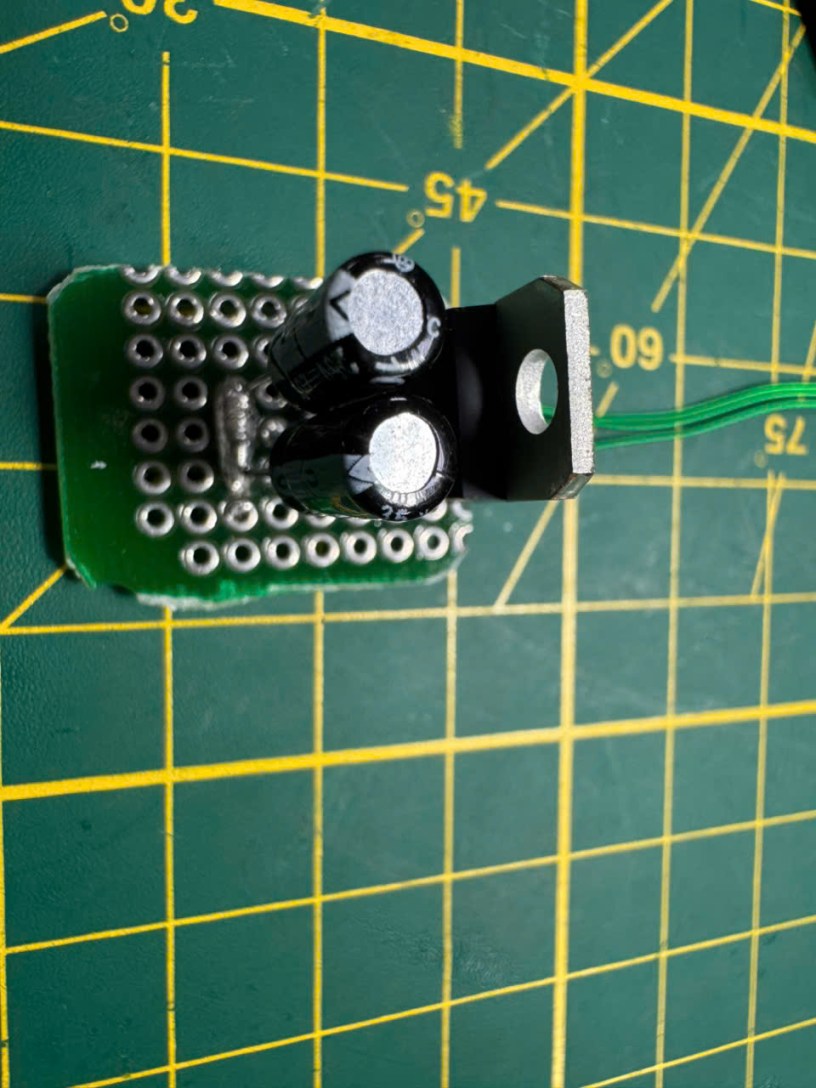
If you’re working on an electronics project that requires converting a higher DC voltage to a stable 5V DC output, the L7805 voltage regulator is a great solution. It’s simple, reliable, and affordable, making it an essential component in many DIY projects. In this article, I’ll guide you through building a basic voltage converter using the L7805.
Note: The L7805 is a linear voltage regulator that provides a stable 5V output. It can handle input voltages ranging from 7V to 35V and provides a maximum output current of 1A. With proper heat dissipation, it’s ideal for powering microcontrollers, sensors, and other 5V devices.
Components
- L7805 Voltage Regulator
- Input Capacitor: 10 µF / 100 µF electrolytic capacitor
- Output Capacitor: 1 µF/ 10 µF ceramic or electrolytic capacitor
- Input Voltage Source: 7-35V DC (e.g., a battery or adapter)
- Wires and Connectors
- Soldering Kit (if building on a PCB or soldering wires)

Circuit Diagram
The basic circuit for the L7805 voltage converter includes:
- Input Voltage (VIN): Connect to the input pin (pin 1) of the L7805.
- Ground (GND): Connect to the middle pin (pin 2) of the L7805.
- Output Voltage (VOUT): Connect to the output pin (pin 3) of the L7805.

Add capacitors for stability:
- Place a 10 µF / 100 µF capacitor between the input pin (VIN) and ground.
- Place a 1 µF/ 10 µF capacitor between the output pin (VOUT) and ground.
Test the Circuit
- Connect your input voltage (e.g., 9V or 12V DC) to the input pin.
- Use a multimeter to measure the output voltage, which should be a stable 5V DC.

Conclusion
The L7805 voltage regulator is a versatile component for providing stable 5V output. With just a few capacitors and minimal wiring, you can create a reliable converter for your electronics projects. This simple setup is perfect for beginners looking to build and understand power regulation.
If you have any questions or suggestions, feel free to leave a comment. Happy building!
 PHAN KHAC HAI