An existing twin tunnels located in Kaohsiung city, Taiwan induced by deep excavation is introduced in this post. It’s a huge monitoring project so both manual and automatic monitoring methods were used during the construction stages to ensure the safety of the deep excavation itself and surrounding structures. In this post, I’m only covering the part of real-time monitoring for the existing twin tunnel induced by deep excavation because the method we used herein was a very special and economical technique that we had not ever carried out before. It’s special because the Least Squared Adjustment method was used to adjust the 3 dimensions of monitoring using Total Station observations. To enable this technique, the commercial software STARNET was adopted to analyze the performance of data collection from the total station in real time. Now lets me introduce a little bit of the Least Squared Adjustment theories applied in this project then I’ll go to more details of the project description such as how to carry out the monitoring and what the results of data analysis look like.
It’s not supervised that the Least Squared Adjustment method was widely used in the survey engineering field to adjust the coordinations for measurement networks due to its accurate estimations. Least-squares adjustment is a method using statistical analysis to estimate the most probable coordinates for measurement points in a network. A single-point coordinate is generally determined from multiple measurements to reduce the errors of measurement (redundant measurements). Due to the measurement containing some degrees of error, the redundant measurements will compute slightly different coordinates for the same point. The weights are computed for each measurement to define the accuracy of the coordinate for the point. The higher the accuracy of the measurement, the higher its weight and the more influence it will have in computing the best-estimate coordinates of the point.
The automatic monitoring using total station instruments is installed inside the two MRT tunnels to observe the movement of tunnel structures as well as the tracks during the adjacent deep excavation construction processes. The plan view of instruments is shown in Figure below, which includes 2 total stations, 2 3D-prisms, and 78 mini-prisms for each MRT tunnel. The total stations and 3D-Prisms are installed in the deformation zone while the benchmark (BM) points (i.e., D533, U33, D65, and U65) are set outside the movement zone. More importantly, the 2 3D-Prisms for each tunnel will be observed by both total stations to improve the accurate measurement of the whole system. The least squared adjustment method using STAR*NET software is adopted to adjust the real-time data collection from the observation system. One of the main factors to adjust the whole data measurement is the result of the Chi-Square Test which is an essential test to determine if the resulting residuals are due to random errors. If the test fails, the errors are likely systematic errors, blunders, or incorrect standard errors. There are two scenarios of making the Chi-Square Test fails: first, exceeding the upper bound indicates excessive residuals and/or maybe the result of too small of standard errors, which must always be fixed; second, exceeding the lower bounds should be evaluated, but is not a cause for concern.

The layout of instruments installation for real-time observation in the tunnels
The two real-time observations adopted from the upper and down MRT tunnel on the date 2021/7/07 are selected to validate the measurement system. All the BM points are allowed to have the maximum standard errors equal to 1 mm for all the directions of North, East, and Elevation. As shown in the 2 Figures below, the Chi-Square tests of these observations are passed that indicate the best fit of adjustment results adopted from real-time measurement. Among different data types such as coordinates, directions, distances, and zeniths, these Error Factors are pretty equal to each other that is approximately within a range of 0.5 to 1.5 as the suggestion of STAR*NET.
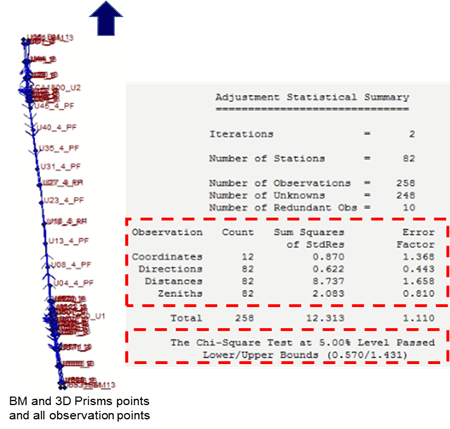
The adjustment summary for upper MRT tunnel
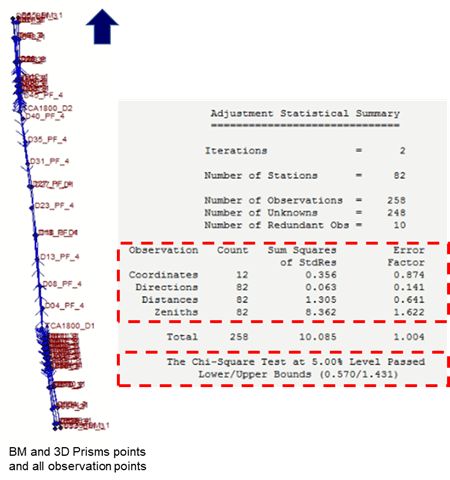
The adjustment summary for down MRT tunnel
 PHAN KHAC HAI